Strategy
A Facebook page feels like enough — until the algorithm buries you or your account gets locked. Here's why Canadian small businesses still need a website they actually own.
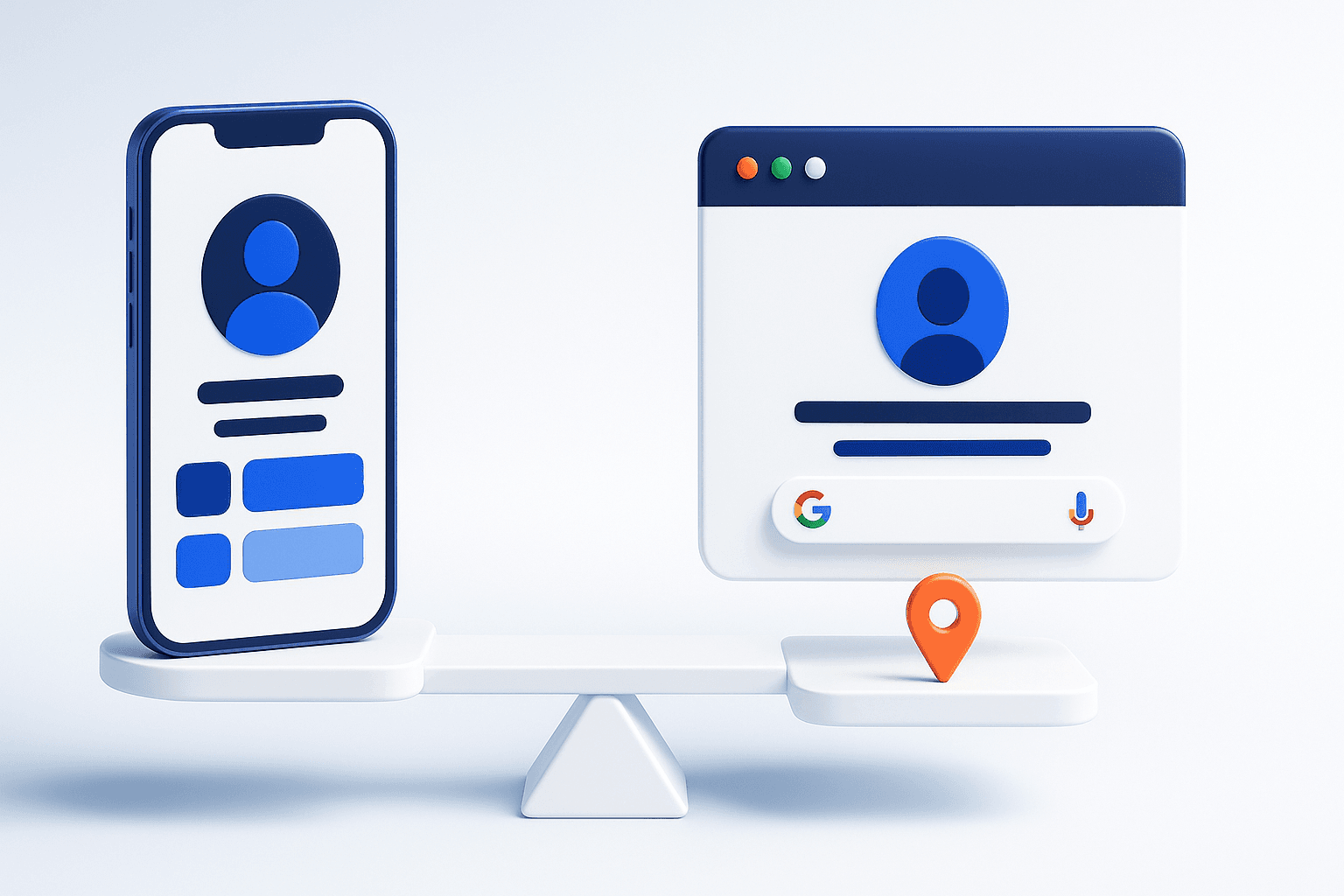
It's a fair question, and a lot of Canadian small business owners ask it: if my Facebook page is busy, my posts get likes, and customers message me there, why am I paying for a website too? The page is free, everyone's already on it, and setting it up took an afternoon. A website feels like an extra expense for something the Facebook page already seems to do.
Here's the honest answer. A Facebook or Instagram page is a genuinely useful tool, and you should keep using it. But it is not a substitute for a website, and treating it like one quietly costs you customers, credibility, and control. The difference comes down to one word that matters more than any feature: ownership. Let's walk through what social does well, what it can't do, and why the two work best together rather than one replacing the other.
Let's give social its due, because the goal here isn't to talk you out of it. A Facebook or Instagram page is excellent at a few specific things, and for an early-stage business those things matter.
It's where people already are. It's free to start. It's built for casual, frequent updates — a photo of today's job, a quick promo, a behind-the-scenes clip. It makes two-way conversation easy, so a customer can fire off a question and you can answer it in the same place they found you. And the share mechanics mean a happy customer can put you in front of their friends with one tap, which is real, valuable word-of-mouth.
So if your social page is bringing in business, good — keep posting. The problem isn't that social is bad. The problem is what happens when it's the only thing you have.
Here's the part most owners don't think about until it bites them. Your Facebook page isn't yours. You don't own the platform, the audience, the reach, or even reliable access to the account. You're building your business on rented land, and the landlord can change the rules — or evict you — without warning.
This isn't hypothetical. Business accounts get locked, hacked, or flagged by automated systems all the time, often for no reason the owner can identify, and getting a human at Meta to fix it can take weeks. People lose years of posts, followers, and customer messages overnight. If your entire customer-facing presence lives on that page, one bad morning can wipe out your only storefront.
A website is land you own. You control the domain, the content, the design, and the data. Nobody can change an algorithm and cut your visibility in half, and nobody can suspend it because a bot misfired. That's why we build every site so you own everything — the domain, the content, all of it. Even if you ever left us, you'd keep your site. You can't say that about a Facebook page.
When you post to your Facebook page, only a small fraction of your followers actually see it. Organic reach for business pages has been shrinking for years, and the platform is increasingly built to push you toward paid ads to reach the audience you already earned. You did the work to get those followers, and now you have to pay to talk to them.
Compare that to how a website earns visibility. When someone in your city searches Google for what you sell, a well-optimized site can show up and bring you a customer who was actively looking — for free, every time, without you posting anything that day. That's the difference between renting attention and owning a channel that works while you sleep.
Search visibility compounds, too. A page you publish today can keep ranking and pulling in leads for years. A Facebook post is buried within hours. If you want to understand how that search visibility actually gets built, our guide on ranking on Google Maps breaks it down for local businesses.
This is the gap that surprises people most. When a potential customer searches "emergency plumber Halifax" or "best med spa near me," Google overwhelmingly serves websites and Google Business Profiles — not Facebook pages. Your social presence is essentially invisible in the moment someone is actively trying to spend money on what you offer.
That moment — high-intent local search — is where a huge share of real buying decisions happen. A business with no website is simply absent from it. You can have ten thousand Instagram followers and still lose the job to a competitor with a basic site that shows up when someone Googles your service at 9pm with a problem to solve.
A website lets you target the actual phrases customers type, build pages for each service and city you serve, and connect to your Google Business Profile so you appear in the map results. That's what local SEO does, and it's something a social page fundamentally can't replace. Search and social are two different channels solving two different problems.
Beyond ownership and search, there's a long list of jobs a website does that a Facebook page can't — and they're exactly the jobs that turn a curious visitor into a paying customer.
None of these live natively on a social page. Facebook is built to keep people on Facebook — not to run your booking calendar, qualify your leads, or follow up on the quote someone requested last Tuesday. Your website is the only place you can wire all of that together into something that actually converts attention into revenue.
This was never really website-versus-Facebook. The businesses that win use both, on purpose, with each doing the job it's good at. Social is the megaphone. Your website is home base.
Here's the model that works. Use Facebook and Instagram to do what they're great at — showing personality, posting frequent updates, sparking conversation, and earning shares. Then point all of that traffic to your website, where the serious work happens: getting found on Google, capturing leads, booking jobs, building credibility, and following up automatically. Social brings people to the door; the site turns them into customers and keeps a record you actually own.
The mistake is pouring years of effort into a presence you rent while owning nothing. If you'd like to see what your owned home base could look like, we'll build you a real preview before you commit a dollar — that's what our free personalized demo is for — a custom homepage for your business you can click through, no payment and no commitment. And because the site, SEO, chatbot, booking, reviews, and CRM all come bundled into one flat monthly plan, you're not stitching together five tools to do what social can't. You keep posting where your customers hang out — and you finally own the place that turns them into paying work.
Ready to act on this?
See what staying social-only is costing you — the Revenue Leak Report prices every leak in dollars and includes an AI preview of your real website. $29.99, credited toward your first month.
Frequently asked
Yes. A busy Facebook page is great, but it's rented space — the algorithm controls who sees you, and the account can be locked or restricted at any time. A website is something you own outright, it shows up when people search Google for your service, and it can capture leads, take bookings, and follow up automatically in ways a social page simply can't. Keep the Facebook page, but don't make it your only presence.
You can run a business on Facebook alone, but you're leaving money and security on the table. You miss every customer who searches Google instead of social, you depend on an algorithm that limits your reach, and you risk losing everything if the account gets suspended. For most Canadian small businesses, the cost of a website is small next to the leads a social-only presence quietly loses.
They do different jobs, so the best results come from using both. Social media is strong for awareness, personality, and word-of-mouth, while a website captures high-intent customers actively searching Google for what you sell and converts them with forms, chat, and booking. Social brings people in; the website turns them into paying customers and follows up so leads don't slip away.
If your presence lives only on Facebook, a lock or suspension can cut off your customers, messages, and posts overnight, and recovering an account can take weeks with no guarantee. A website you own isn't exposed to that risk — your domain, content, and customer data stay under your control. That's one of the biggest reasons to have a home base you actually own.
We're building 100 complete custom websites for Canadian small businesses, plus 50% off your first month on any plan. Claim a spot before the timer runs out.

 Canadian team